I’m one of hundreds of University of Michigan alumni currently working at Google. So is this guy. I’m proud to have a degree from U-M—and that we made it to two Rose Bowls and one Final Four during my time there. But I’m even more proud that today we’re welcoming my alma mater to the Google Apps for Education family. By providing our cloud services to the entire university community, we’ll continue to build on the strong relationship that Google and the University of Michigan have had for many years. Many other alums—especially in our Ann Arbor office—are just as excited as I am:
Over a year ago, the University of Michigan (U-M) announced a new IT strategy known as NextGen Michigan, a plan to upgrade technology across the campus. Laura Patterson, U-M’s Chief Information Office, told us the switch to Google is just one of many projects that will make up U-M’s multi-year strategy for changing the approach to IT service and investing more heavily in technologies that will advance the university’s academic, teaching, research and clinical programs. She said: “Adopting Google Apps for Education will help support U-M’s leadership in teaching, learning and discovery, as well as improve collaboration across campus.”
As their first order of business, U-M kicked off a project to select a unified messaging and collaboration platform to help consolidate the more than 40 email and calendar tools which currently service about 90,000 students, faculty and staff. After a review process that included townhall meetings and a campus survey, the university’s IT steering committee overwhelmingly recommended Google Apps for Education as U-M’s preferred provider.
In addition to the suite of products in Google Apps for Education, U-M also plans to use APIs to build rich integration with existing campus services and encourage increased collaboration.
Hail to the Victors—The University of Michigan is going Google!
Wednesday, November 2, 2011


Tuesday, November 1, 2011
Take a walk in the park with Street View
Whether you’re planning a trip to a park around the block or around the world, you’ll now find more parks showing up in Street View. Over the past year, the Street View team, equipped with the Street View trike, traveled to 22 different countries to photograph some of the world’s most beautiful and unique parks. Starting today, you can explore the couple hundred new special collections we’ve added by visiting our gallery.
You can now tour High Line, which sits 30 feet in the air, over the bustling streets of New York City. The park sits on an elevated freight train spur that spans 1.5 miles and cuts through the western side of Manhattan. Because of Robert Hammond and Joshua David’s efforts, visitors can experience an innovative park that would have otherwise been a demolished urban structure.
You can tour the park in Street View here:
Across the pond, you can visit Kensington Gardens in London. Once privately owned by Kensington Palace, the majestic arbor skyline and delicate flower beds draw locals and tourists alike. Kensington Gardens is also dotted with famous statues, such as Peter Pan, and home to the idyllic Serpentine Bridge.
Community parks are where we take our evening stroll, play sports on weekends and picnic with friends. Koganei Park in Tokyo, Japan is one such place, especially during the cherry blossom season—a charming park beloved by photographers, joggers and romantics.
You can see more Street View special collections in this gallery or get inspired to travel with this video.
(Cross-posted from the Lat Long Blog)
You can now tour High Line, which sits 30 feet in the air, over the bustling streets of New York City. The park sits on an elevated freight train spur that spans 1.5 miles and cuts through the western side of Manhattan. Because of Robert Hammond and Joshua David’s efforts, visitors can experience an innovative park that would have otherwise been a demolished urban structure.
Across the pond, you can visit Kensington Gardens in London. Once privately owned by Kensington Palace, the majestic arbor skyline and delicate flower beds draw locals and tourists alike. Kensington Gardens is also dotted with famous statues, such as Peter Pan, and home to the idyllic Serpentine Bridge.
Community parks are where we take our evening stroll, play sports on weekends and picnic with friends. Koganei Park in Tokyo, Japan is one such place, especially during the cherry blossom season—a charming park beloved by photographers, joggers and romantics.
You can see more Street View special collections in this gallery or get inspired to travel with this video.
(Cross-posted from the Lat Long Blog)
Gmail’s new look
Back in July we showed you a preview of Gmail's new look, and we’ve been working this summer to make even more updates and improvements. Today, we’re giving you an in-depth look at the new design. If you like what you see, over the next few days you’ll be able to switch to the new look by clicking on Switch to the new look in the bottom-right of Gmail.
Streamlined conversations
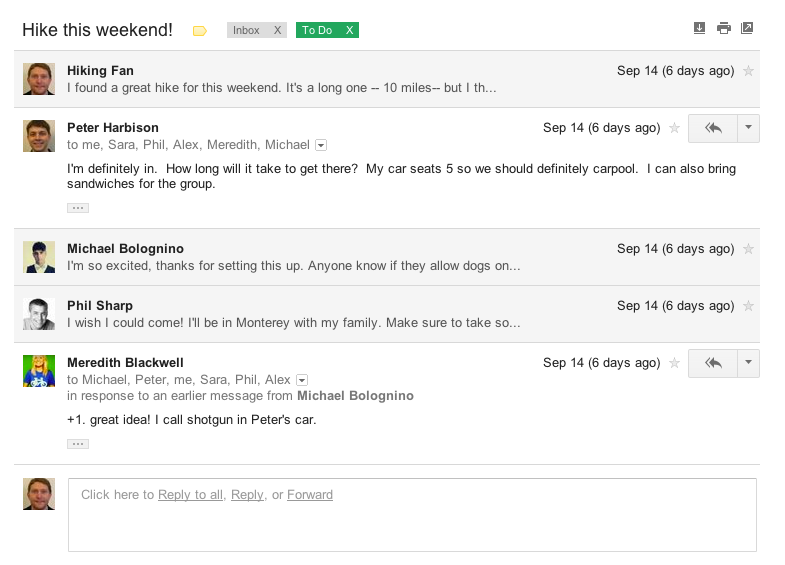
Conversation view has been completely redesigned to help you read through your email threads. You’ll now see profiles pictures for your contacts, so it’s easier to keep track of who said what. We also stripped out as much as possible so you can focus on communicating with your friends and colleagues.

Elastic density
We know that you use Gmail from a variety of screen sizes and devices, so now the spacing between elements on the screen will automatically change based on the kind of display you’re using. If you prefer a denser view all the time, you can change your density manually in the Settings menu.

New HD themes
Themes have been completely rebuilt to enable us to bring you a new set of beautiful high resolution themes with imagery provided by iStockphoto. We've updated most of the old favorites as well and your theme will be automatically carried over to the new look. Go to the Settings menu to take another look at themes and choose the one that fits you best.

Smarter navigation
The navigation panel on the left keeps your labels and chat contacts in view at all times. It's also more customizable: you can resize the labels and chat areas if you want to see more, or hide the chat area entirely via the chat icon in the lower left. You can also use the arrow keys to navigate around the interface.

Better search
Click the dropdown in the search box to see a new advanced search panel, which makes it easier and faster to find exactly what you're looking for. You can use the same panel to create a filter from any search in just a few clicks.

We’re excited to finally share Gmail’s new look with you. We’ll be bringing these changes to everyone soon, but if you’d like to make the switch right away, we’re rolling out a Switch to the new look link in the bottom-right of Gmail over the next few days.
(Cross-posted from the Gmail Blog)
Streamlined conversations
Conversation view has been completely redesigned to help you read through your email threads. You’ll now see profiles pictures for your contacts, so it’s easier to keep track of who said what. We also stripped out as much as possible so you can focus on communicating with your friends and colleagues.
Elastic density
We know that you use Gmail from a variety of screen sizes and devices, so now the spacing between elements on the screen will automatically change based on the kind of display you’re using. If you prefer a denser view all the time, you can change your density manually in the Settings menu.

New HD themes
Themes have been completely rebuilt to enable us to bring you a new set of beautiful high resolution themes with imagery provided by iStockphoto. We've updated most of the old favorites as well and your theme will be automatically carried over to the new look. Go to the Settings menu to take another look at themes and choose the one that fits you best.

Smarter navigation
The navigation panel on the left keeps your labels and chat contacts in view at all times. It's also more customizable: you can resize the labels and chat areas if you want to see more, or hide the chat area entirely via the chat icon in the lower left. You can also use the arrow keys to navigate around the interface.

Better search
Click the dropdown in the search box to see a new advanced search panel, which makes it easier and faster to find exactly what you're looking for. You can use the same panel to create a filter from any search in just a few clicks.

We’re excited to finally share Gmail’s new look with you. We’ll be bringing these changes to everyone soon, but if you’d like to make the switch right away, we’re rolling out a Switch to the new look link in the bottom-right of Gmail over the next few days.
(Cross-posted from the Gmail Blog)
Thursday, September 29, 2011
Fresh Perspectives about People and the Web from Think Quarterly
There’s a lot of research, analysis and insights—from inside and outside Google—that we use in building our products and making decisions. To share what we’ve learned with our partners, we created Think Quarterly. It’s intended to be a snapshot of what Google and other industry leaders are talking about and inspired by right now.
Today we’re launching our second edition, the “People” issue, exploring the latest technologies connecting us and the big ideas driving society forward. It also includes some of the research and analysis that helps us shape our strategies.
For those who love data as much as we do, here are a few articles worth reading:
- “Following Generation Z,” in which Google research scientist Ed Chi details what he’s learned from monitoring the course of digital innovation and mapping patterns of digital technology use in the future
- “Predicting the Present,” by chief economist Hal Varian, about how publicly available search tools can help anyone gain valuable insights into the behavior of web users and predict what they might do next
- “Power to the People,” by Meg Pickard, anthropologist turned head of digital engagement at Guardian News and Media, about tracking the influence and power of online communities
- “From Cash to Contentment,” about the use of happiness as a measurable metric of success, with insights coming from Nobel Prize winner Joseph Stiglitz
Click here to read all the articles, and if you have a suggestion for our next issue please tell us here. We hope you enjoy (and +1) it!
Wednesday, September 28, 2011
Trying on the new Dynamic Views from Blogger
As you may have noticed, the Google Research blog looks a lot different today. That’s because we—along with a few other Google blogs—are trying out a new set of Blogger templates called Dynamic Views.
Launched today, Dynamic Views is a unique browsing experience that makes it easier and faster for readers to explore blogs in interactive ways. We’re using the Magazine view, but you can also preview this blog in any of the other six new views by using the view selection bar at the top left of the screen.
We’re eager to hear what you think about the new Dynamic Views. You can submit feedback using the “Send feedback” link on the bottom right of this page.
If you like what you see here, and we hope you do, we encourage you to try out the new look(s) on your own blog—read the Blogger Buzz post for more info.
Thursday, September 8, 2011
Sorting Petabytes with MapReduce - The Next Episode
Almost three years ago we announced results of the first ever "petasort" (sorting a petabyte-worth of 100-byte records, following the Sort Benchmark rules). It completed in just over six hours on 4000 computers. Recently we repeated the experiment using 8000 computers. The execution time was 33 minutes, an order of magnitude improvement.
Our sorting code is based on MapReduce, which is a key framework for running multiple processes simultaneously at Google. Thousands of applications, supporting most services offered by Google, have been expressed in MapReduce. While not many MapReduce applications operate at a petabyte scale, some do. Their scale is likely to continue growing quickly. The need to help such applications scale motivated us to experiment with data sets larger than one petabyte. In particular, sorting a ten petabyte input set took 6 hours and 27 minutes to complete on 8000 computers. We are not aware of any other sorting experiment successfully completed at this scale.
We are excited by these results. While internal improvements to the MapReduce framework contributed significantly, a large part of the credit goes to numerous advances in Google's hardware, cluster management system, and storage stack.
What would it take to scale MapReduce by further orders of magnitude and make processing of such large data sets efficient and easy? One way to find out is to join Google’s systems infrastructure team. If you have a passion for distributed computing, are an expert or plan to become one, and feel excited about the challenges of exascale then definitely consider applying for a software engineering position with Google.
Tuesday, August 23, 2011
Google at the Joint Statistical Meetings in Miami
The Joint Statistical Meetings (JSM) were held in Miami, Florida, this year. Nearly 5,000 participants from academia and industry came to present and discuss the latest in statistical research, methodology, and applications. Similar to previous years, several Googlers shared expertise in large-scale experimental design and implementation, statistical inference with massive datasets and forecasting, data mining, parallel computing, and much more.
Our session "Statistics: The Secret Weapon of Successful Web Giants" attracted over one hundred people; surprising for an 8:30 AM session! Revolution Analytics reviewed this in their official blog post "How Google uses R to make online advertising more effective"
The following talks were given by Googlers at JSM 2011. Please check the upcoming Proceedings of the JSM 2011 for the full papers.
- Statistical Plumbing: Effective use of classical statistical methods for large scale applications
- Author(s): Ni Wang, Yong Li, Daryl Pregibon, and Rachel Schutt
- Parallel Computations in R, with Applications for Statistical Forecasting
- Author(s): Murray Stokely and Farzan Rohani and Eric Tassone
- Conditional Regression Models
- Author(s): William D. Heavlin
- The Effectiveness of Display Ads
- Author(s): Tim Hesterberg and Diane Lambert and David X. Chan and Or Gershony and Rong Ge
- Measuring Ad Effectiveness Using Continuous Geo Experiments
- Author(s): Jon Vaver and Deepak Kumar and Jim Koehler
- Post-Stratification and Network Sampling
- Author(s): Rachel Schutt and Andrew Gelman and Tyler McCormick
We also hosted the Google faculty reception, which was well-attended by faculty and their promising students. Google hires a growing number of statisticians and we were happy to participate in JSM again this year. People had a chance to talk to Googlers, ask about working here, encounter elements of Google culture (good food! T-shirts! 3D puzzles!), meet old and make new friends, and just have fun!
Thanks to everyone that presented, attended, or otherwise engaged with the statistical community at JSM this year. We’re looking forward to seeing you in San Diego next year.
Tuesday, August 16, 2011
A new MIT center for mobile learning, with support from Google
MIT and Google have a long-standing relationship based on mutual interests in education and technology. Today, we took another step forward in our shared goals with the establishment of the MIT Center for Mobile Learning, which will strive to transform learning and education through innovation in mobile computing. The new center will be actively engaged in studying and extending App Inventor for Android, which Google recently announced it will be open sourcing.
The new center, housed at MIT’s Media Lab, will focus on designing and studying new mobile technologies that enable people to learn anywhere, anytime, with anyone. The center was made possible in part by support from Google University Relations and will be run by myself and two distinguished MIT colleagues: Professors Eric Klopfer (science education) and Mitchel Resnick (media arts and sciences).
App Inventor for Android—a programming system that makes it easy for learners to create mobile apps for Android smartphones—currently supports a community of about 100,000 educators, students and hobbyists. Through the new initiatives at the MIT Center for Mobile Learning, App Inventor will be connected to MIT’s premier research in educational technology and MIT’s long track record of creating and supporting open software.
Google first launched App Inventor internally in order to move it forward with speed and focus, and then developed it to a point where it started to gain critical mass. Now, its impact can be amplified by collaboration with a top academic institution. At MIT, App Inventor will adopt an enriched research agenda with increased opportunities to influence the educational community. In a way, App Inventor has now come full circle, as I actually initiated App Inventor at Google by proposing it as a project during my sabbatical with the company in 2008. The core code for App Inventor came from Eric Klopfer’s lab, and the inspiration came from Mitch Resnick’s Scratch project. The new center is a perfect example of how industry and academia can collaborate effectively to create change enabled by technology, and we look forward to seeing what we can do next, together.
Saturday, August 13, 2011
Our Faculty Institute brings faculty back to the drawing board
Posted by Nina Kim Schultz, Google Education Research
Cross-posted with the Official Google Blog
School may still be out for summer, but teachers remain hard at work. This week, we hosted Google’s inaugural Faculty Institute at our Mountain View, Calif. headquarters. The three-day event was created for esteemed faculty from schools of education and math and science to explore teaching paradigms that leverage technology in K-12 classrooms. Selected via a rigorous nomination and application process, the 39 faculty members hail from 19 California State Universities (CSUs), as well as Stanford and UC Berkeley, and teach high school STEM (Science, Technology, Engineering and Math) teachers currently getting their teaching credentials. CSU programs credential 60 percent of California’s teachers—or 10 percent of all U.S. K-12 teachers—and one CSU campus alone can credential around 1,000 new teachers in a year. The purpose of gathering together at the Institute was to ensure our teachers’ teachers have the support they need to help educators adjust to a changing landscape.
There is so much technology available to educators today, but unless they learn how to use it effectively, it does little to change what is happening in our classrooms. Without the right training and inspiration, interactive displays become merely expensive projection screens, and laptops simply replace paper rather than shifting the way teachers teach and students learn. Although the possibilities for technology use in schools are endless, teacher preparation for the 21st century classroom also has many constraints. For example: beyond the expense involved, there’s the time it costs educators to match a technological innovation to the improvement of pedagogy and curriculum; there’s a distinct shift in thinking that needs to take place to change classrooms; and there’s an essential challenge to help teachers develop the dispositions and confidence to be lifelong evaluators, learners and teachers of technology, instead of continuing to rely on traditional skill sets that will soon be outdated.
The Institute featured keynote addresses from respected professors from Stanford and Berkeley, case studies from distinguished high school teachers from across California, hands-on technology workshops with a variety of Google and non-Google tools, and panels with professionals in the tech-education industry. Notable guests included representatives from Teach for America, The New Teacher Project, the Department of Education and Edutopia. Topics covered the ability to distinguish learning paths, how to use technology to transform classrooms into project-based, collaborative spaces and how to utilize a more interactive teaching style rather than the traditional lecture model.
On the last day of the Institute, faculty members were invited to submit grant proposals to scale best practices outside of the meeting. Deans of the participating universities will convene at the end of the month to further brainstorm ways to scale new ideas in teacher preparation programs. Congratulations to all of the faculty members who were accepted into the inaugural Institute, and thank you for all that you do to help bring technology and new ways of thinking into the classroom.

This program is a part of Google’s continued commitment to supporting STEM education. Details on our other programs can be found on www.google.com/education.
Cross-posted with the Official Google Blog
School may still be out for summer, but teachers remain hard at work. This week, we hosted Google’s inaugural Faculty Institute at our Mountain View, Calif. headquarters. The three-day event was created for esteemed faculty from schools of education and math and science to explore teaching paradigms that leverage technology in K-12 classrooms. Selected via a rigorous nomination and application process, the 39 faculty members hail from 19 California State Universities (CSUs), as well as Stanford and UC Berkeley, and teach high school STEM (Science, Technology, Engineering and Math) teachers currently getting their teaching credentials. CSU programs credential 60 percent of California’s teachers—or 10 percent of all U.S. K-12 teachers—and one CSU campus alone can credential around 1,000 new teachers in a year. The purpose of gathering together at the Institute was to ensure our teachers’ teachers have the support they need to help educators adjust to a changing landscape.
There is so much technology available to educators today, but unless they learn how to use it effectively, it does little to change what is happening in our classrooms. Without the right training and inspiration, interactive displays become merely expensive projection screens, and laptops simply replace paper rather than shifting the way teachers teach and students learn. Although the possibilities for technology use in schools are endless, teacher preparation for the 21st century classroom also has many constraints. For example: beyond the expense involved, there’s the time it costs educators to match a technological innovation to the improvement of pedagogy and curriculum; there’s a distinct shift in thinking that needs to take place to change classrooms; and there’s an essential challenge to help teachers develop the dispositions and confidence to be lifelong evaluators, learners and teachers of technology, instead of continuing to rely on traditional skill sets that will soon be outdated.
The Institute featured keynote addresses from respected professors from Stanford and Berkeley, case studies from distinguished high school teachers from across California, hands-on technology workshops with a variety of Google and non-Google tools, and panels with professionals in the tech-education industry. Notable guests included representatives from Teach for America, The New Teacher Project, the Department of Education and Edutopia. Topics covered the ability to distinguish learning paths, how to use technology to transform classrooms into project-based, collaborative spaces and how to utilize a more interactive teaching style rather than the traditional lecture model.
On the last day of the Institute, faculty members were invited to submit grant proposals to scale best practices outside of the meeting. Deans of the participating universities will convene at the end of the month to further brainstorm ways to scale new ideas in teacher preparation programs. Congratulations to all of the faculty members who were accepted into the inaugural Institute, and thank you for all that you do to help bring technology and new ways of thinking into the classroom.

This program is a part of Google’s continued commitment to supporting STEM education. Details on our other programs can be found on www.google.com/education.
Thursday, August 11, 2011
Culturomics, Ngrams and new power tools for Science
Four years ago, we set out to create a research engine that would help people explore our cultural history by statistically analyzing the world’s books. In January 2011, the resulting method, culturomics, was featured on the cover of the journal Science. More importantly, Google implemented and launched a web-based version of our prototype research engine, the Google Books Ngram Viewer.
Now scientists, scholars, and web surfers around the world can take advantage of the Ngram Viewer to study a vast array of phenomena. And that's exactly what they've done. Here are a few of our favorite examples.
Poverty
Martin Ravallion, head of the Development Research Group at the World Bank, has been using the ngrams to study the history of poverty. In a paper published in the journal Poverty and Public Policy, he argues for the existence of two ‘poverty enlightenments’ marked by increased awareness of the problem: one towards the end of the 18th century, and another in the 1970s and 80s. But he makes the point that only the second of these enlightenments brought with it a truly enlightened idea: that poverty can be and should be completely eradicated.
The Science Hall of Fame
Adrian Veres and John Bohannon wondered who the most famous scientists of the past two centuries were. But there was no hall of fame for scientists, or a committee that determines who deserves to get into such a hall. So they used the ngrams data to define a metric for celebrity – the milliDarwin – and algorithmically created a Science Hall of Fame listing the most famous scientists born since 1800. They found that things like a popular book or a major controversy did more to increase discussion of a scientist than, for instance, winning a Nobel Prize.
(Other users have been exploring the history of particular sciences with the Ngram Viewer, covering everything from neuroscience to the nuclear age.)
The History of Typography
When we introduced the Ngram Viewer, we pointed out some potential pitfalls with the data. For instance, the ‘medial s’ ( ſ ), an older form of the letter s that looked like an integral sign and appeared in the beginning or middle of words, tends to be classified as an instance of the letter ‘f’ by the OCR algorithm used to create our version of the data. Andrew West, blogging at Babelstone, found a clever way to exploit this error: using queries like ‘husband’ and ‘hufband’ to study the history of medial s typography, he pinned down the precise moment when the medial s disappeared from English (around 1800), French (1780), and Spanish (1760).
People are clearly having a good time with the Ngram Viewer, and they have been learning a few things about science and history in the process. Indeed, the tool has proven so popular and so useful that Google recently announced that its imminent graduation from Google Labs to become a permanent part of Google Books.
Similar ‘big data’ approaches can also be applied to a wide variety of other problems. From books to maps to the structure of the web itself, 'the world's information' is one amazing dataset.
Erez Lieberman Aiden is Visiting Faculty at Google and a Fellow of the Harvard Society of Fellows. Jean-Baptiste Michel is Visiting Faculty at Google and a Postdoctoral Fellow in Harvard's Department of Psychology.
Subscribe to:
Posts (Atom)